
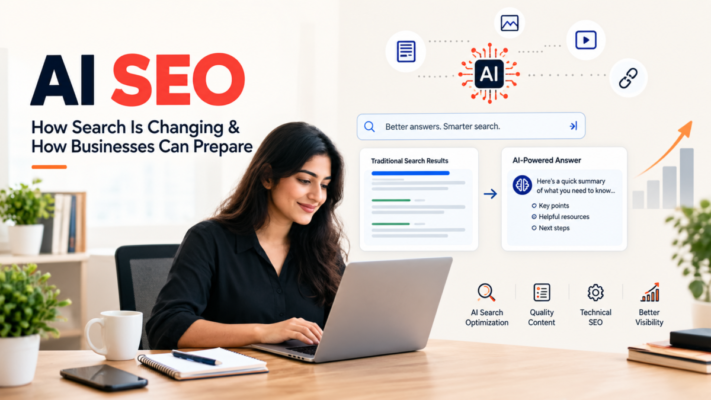
Search is changing.
People are no longer relying only on traditional lists of blue links to discover information. Search experiences increasingly include AI-generated answers, conversational interactions, visual results and other formats.
For businesses, this doesn’t mean SEO is disappearing.
Instead, the way businesses approach SEO needs to become more thoughtful.
The future of SEO in India will involve understanding traditional search, AI-powered search experiences and the changing ways customers discover information.
How Is AI Changing Search?
AI can help search systems understand the meaning behind a query rather than simply matching individual words.
For businesses, this means creating content around a topic is becoming more important than repeatedly inserting one exact keyword.
Imagine someone searches:
“How can I promote my new clothing brand online?”
They may be looking for information about SEO, Instagram, Meta Ads, content creation, influencers, websites or Google Ads.
A useful business resource should help answer the broader problem rather than obsess over one keyword.
SEO Is Not Just About Keywords
.
Keywords are still useful because they help you understand what people are searching for.
But good SEO requires more.
A strong page should:
- Answer the user’s question
- Be easy to navigate
- Provide original information
- Demonstrate relevant knowledge
- Use useful headings
- Connect to related pages
- Be accessible on different devices
Google’s current Search guidance continues to emphasize useful, people-first content rather than content created primarily to manipulate search rankings.
What Is AI SEO?
AI SEO is commonly used to describe strategies aimed at maintaining visibility as search becomes more AI-driven.
You’ll also hear related terms such as:
- AI Search Optimization
- Answer Engine Optimization
- Generative Engine Optimization
- Search Experience Optimization
These terms describe overlapping areas of an evolving search environment rather than completely separate replacements for SEO.
The fundamentals still matter.
Your website needs useful information that search systems can understand and users can benefit from.
Create Content Around Real Customer Questions
One of the best ways to prepare for changing search behaviour is to understand what your customers actually want to know.
For example, instead of creating an article titled:
“Digital Marketing Services”
you could create:
“How Should a New Brand Build Its Digital Presence?”
The second topic addresses a real business problem.
From there, you can naturally discuss:
- Website marketing
- SEO
- Social media
- Content
- Google Ads
- Meta Ads
- Visual branding
This creates content that can be useful at different stages of the customer’s decision-making process.
Build Topic Depth
One article rarely establishes strong expertise around an entire subject.
Instead, create connected resources.
For example:
SEO
→ Keyword Research
→ On-Page SEO
→ Technical SEO
→ Local SEO
→ SEO Content
→ AI Search
→ SEO Measurement
Then link relevant articles together.
This helps visitors move from a basic question to a deeper understanding of the subject.
Don’t Create Hundreds of AI-Generated Articles
AI makes it easier to produce content.
That doesn’t mean businesses should publish hundreds of generic articles.
Google’s spam guidance specifically warns against scaled content created primarily to manipulate search rankings, including low-value content generated at scale.
Instead, use AI and other tools to support research, planning and editing while making sure the finished article contains genuine value and original thinking.
What Should Businesses Do Now?
Businesses preparing for the changing search environment should focus on:
1. Improve Their Website
Make sure important pages are easy to find, understand and navigate.
2. Create Helpful Content
Answer customer questions rather than writing solely for search engines.
3. Build Topical Depth
Cover important subjects related to your products and services.
4. Strengthen Brand Recognition
People should be able to recognize and trust your business across your website and social channels.
5. Use First-Hand Knowledge
Your own experiences, processes, examples and observations can make your content more distinctive.
The Future of SEO Is Still About Relevance
AI may change how search results are presented, but businesses still need to provide something useful.
A website that clearly explains its services, answers customer questions and demonstrates genuine expertise has a stronger foundation than one built around keyword repetition.
The future of SEO isn’t simply about finding the next algorithm trick.
It’s about becoming a useful source of information in your industry.
Explore my SEO and digital marketing services to create a strategy built around your audience, content and business goals.